

Among trees and stories: remarkable places where Arbolab had the pleasure of working.
Working with trees is also a way to learn about history.
Throughout Arbolab's history, we have had the pleasure of carrying out projects and training in different regions of the country. Some took place in locations that help tell the national story. Others were conducted in conservation areas, unique natural landscapes, and training centers responsible for preparing teams to operate in emergency situations.
In each location, we encountered different trees, people, and challenges. Climbing, pruning, chainsaw operation, rescue, and tree management techniques had to be applied with planning and respect for the characteristics of each environment.
This article brings together some of those moments.
Catetinho, Brasília: arboriculture in the place where the new capital began.
In Brasília, we had the opportunity to conduct training in tree climbing and pruning, as well as activities focused on the safe operation of chainsaws, at Catetinho.
Wooden construction plays a special role in the country's history. Catetinho was Juscelino Kubitschek's first official residence in Brasília and became known as one of the initial landmarks of the new capital. Conducting an arboriculture course in this setting was a symbolic experience: in a place linked to the beginning of one of Brazil's largest urban projects, we worked on contemporary techniques for the responsible management of trees and for the safety of professionals working at heights.
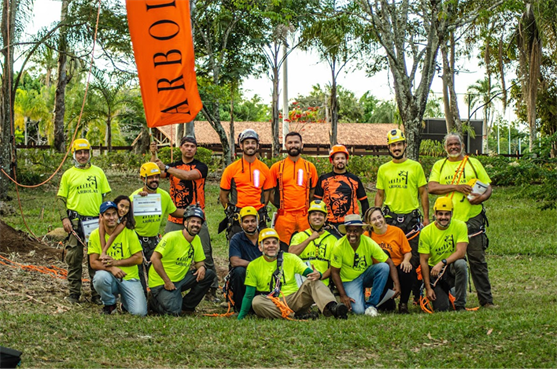
Group gathered during Arbolab training at Catetinho, in Brasília.

Preparing climbing equipment during a practical activity.

Class photo with technical support and arboriculture equipment.

Instructors engaged in a practical tree climbing activity.

Equipment and staff undergoing training in green areas.
Roberto Burle Marx Site, Rio de Janeiro: climbing a world heritage site
In Rio de Janeiro, one of the training sessions took place at the Roberto Burle Marx Site, in Barra de Guaratiba.
The site is recognized for the importance of Roberto Burle Marx to modern Brazilian and world landscape design. In 2021, the site was recognized as a World Cultural Heritage Site by UNESCO. Amidst the vegetation and botanical diversity of the place, we carry out practical activities of tree climbing and rope access techniques.
More than just a privileged setting, the site reminds us that tree management should always be linked to knowledge of the species, environmental preservation, and care for the plant heritage.

Introductory class at the Roberto Burle Marx Site.
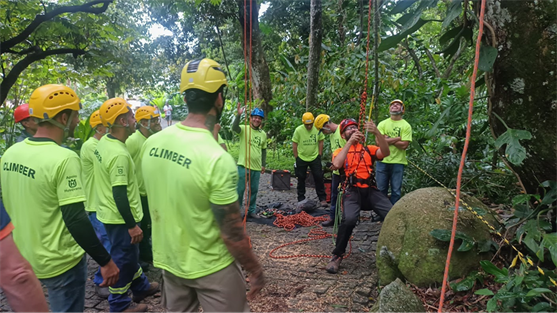
Practical demonstration of rope access systems.

Technical guidance in a wooded area of the property.

Technical instruction session during the course.
Quinta da Boa Vista, Rio de Janeiro: training session in front of the former Imperial Palace.
Also in Rio de Janeiro, we held a course on chainsaw operation, pruning, and tree climbing at Quinta da Boa Vista, in front of the Paço de São Cristóvão, the historic headquarters of the National Museum of the Federal University of Rio de Janeiro.
The palace was the residence of the Brazilian royal and imperial family, and the gardens of Quinta da Boa Vista were designed by Auguste Glaziou in the 19th century. Training professionals responsible for the management of urban trees in this space reinforces an important idea: trees are also part of the memory of cities.
The preservation of historic green areas requires technique, planning, and professionals trained to work safely.

Closing ceremony of the course at Quinta da Boa Vista.

Practical climbing activity observed by the team.
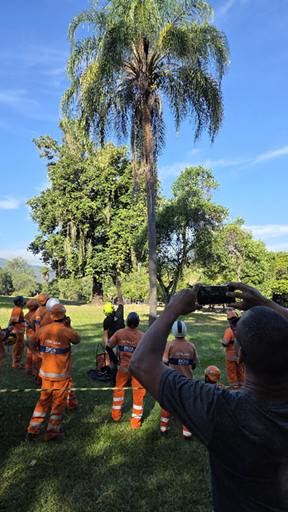
Orientation in an open area during training.
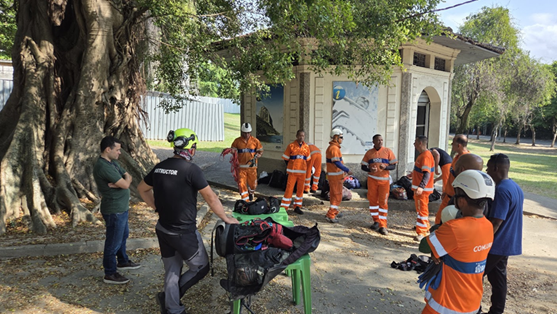
Preparation and organization of climbing equipment.
On the banks of the Paraguay River, in Mato Grosso: training in a unique landscape.
In Mato Grosso, Arbolab conducted training for members of the Fire Department and Army teams, with activities including tree climbing and chainsaw operation on the banks of the Paraguay River.
The setting is directly related to the dynamics of the Pantanal, one of the largest continental wetlands on the planet, located within the Upper Paraguay River basin. In this environment, the practical activities involved preparing the equipment, organizing the climbing systems, accessing the trees, and providing guidance on the correct use of the chainsaw.
Experience has shown how arboriculture techniques can also contribute to the training of teams that need to operate in extensive natural areas, with operational conditions very different from those found in urban centers.

Instructions on chainsaw operation for emergency teams.

Preparing the climbing systems before the practical activity.

Tree climbing exercise with technical supervision.

The team observes practical climbing and positioning activities.
Ilha dos Arvoredos, Guarujá: tree management in a sustainability laboratory.
On the coast of São Paulo, Arbolab had the pleasure of participating in a technical project on Ilha dos Arvoredos, in Guarujá.
The island is associated with the engineer Fernando Eduardo Lee and projects focused on research, sustainability, and the use of self-sufficiency solutions. The images record access to the trees and the execution of technical activities at height in an island environment, surrounded by coastal vegetation and the sea.
Working at this location was an opportunity to combine technical knowledge, planning, and respect for a space with a history directly associated with environmental research.

Recording at height during a technical project on Ilha dos Arvoredos.

Technical operation with a chainsaw in an island environment.

Tree climbing using a rope access system.

Coastal landscape of Ilha dos Arvoredos during the project.
Firefighters Academy, Franco da Rocha: rescue of paragliders and parachutes stuck in trees.
At the Firefighters Academy in Franco da Rocha, we participated in specialized training in tree rescue.
During the course, practical exercises were conducted focusing on responding to incidents involving paragliders and parachutes entangled in trees. These situations require careful assessment before the start of the operation. The team needs to analyze the stability of the tree, select safe anchor points, understand the victim's position, and consider the risks related to the canopy and the equipment's lines.
The activities included rope access, safe approach, organization of rescue systems, and controlled extraction of the victim.

Instructor and participant after a tree rescue exercise.

Simulation of a parachute or paragliding rescue in a wooded area.

The team observes a practical exercise in controlled withdrawal.
São Luís, Maranhão: Firefighter training in a historic city.
In São Luís, we conducted a chainsaw operation and tree climbing course for teams from the Maranhão Fire Department.
The capital of Maranhão has a unique history. Founded in the 17th century, São Luís preserves a historic center recognized as a World Heritage Site by UNESCO. The training included technical guidance, practical demonstrations, equipment organization, and activities focused on the correct use of chainsaws and tree access systems.
Bringing this knowledge to emergency teams in different regions of the country expands their response capacity in incidents involving trees, controlled cutting, and working at heights.

Closing ceremony of the course with firefighters from Maranhão, in São Luís.

Practical lesson on the safe operation of chainsaws.
São José dos Pinhais, Paraná: technical training for firefighting teams
At the Paraná Military Firefighters Academy, in São José dos Pinhais, we conducted a course on tree climbing and chainsaw operation.
São José dos Pinhais has a history linked to the historical formation of Paraná and the metropolitan region of Curitiba. The practical activities covered climbing equipment, access systems, techniques applied to working in trees, and necessary precautions for the safe operation of chainsaws in emergency scenarios.
This type of training strengthens the performance of firefighting teams in incidents involving trees, high-altitude rescues, emergency branch handling, and the safe use of cutting equipment in real-life situations.

Class from the course at the Higher School of Military Firefighters of Paraná.
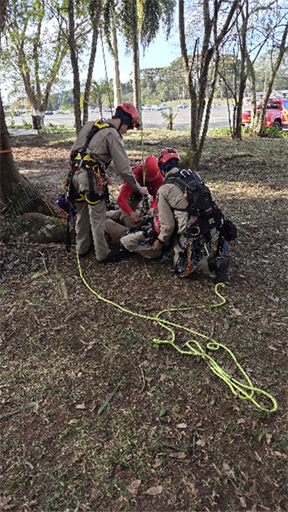
Practical exercise with climbing equipment.

Participants and instructors gathered at the end of the training.
Bauru Botanical Garden: climbing applied to seed collection
At the Bauru Municipal Botanical Garden, we conducted a training course focused on collecting seeds from trees.
Established in 1994, the Bauru Botanical Garden preserves a significant area of cerrado (Brazilian savanna), in addition to other vegetation formations. Collecting tree seeds requires planning, knowledge of the tree, and mastery of climbing techniques. In many cases, the material needs to be collected directly from the canopy, necessitating the use of rope access techniques and safe positioning.
This course demonstrated a very important application of tree climbing: supporting conservation projects, seedling production, research, and environmental restoration.

Practical climbing activity for seed collection.

Access to the tree canopy during seed collection training.
Ibirapuera Park, São Paulo: tree climbing in the heart of the city.
In São Paulo, we held a tree climbing course in Ibirapuera Park.
Inaugurated in 1954 during the celebrations of the fourth centenary of the city of São Paulo, the park has become one of the best-known urban spaces in the country. During the training, fundamentals of anchoring, rope access, positioning, and movement in the tree were covered.
Taking a course in Ibirapuera Park also reinforces the importance of professionals who care for urban trees. The trees present in parks, squares, and public roads are part of the quality of life, the landscape, and the identity of cities.

Closing ceremony of the climbing course at Ibirapuera Park.

Instructor working at heights during a practical activity in Ibirapuera Park.

Practical lesson on anchoring and safety in urban trees.
Trees, technique and memory
Each of these experiences left a different lesson.
We visited spaces connected to the construction of Brasília, the landscaping of Roberto Burle Marx, the history of the imperial family, the conservation of the Cerrado biome, sustainability on an island, the preparation of emergency teams, and the management of trees in important urban parks.
The photographs document courses and projects, but they also show something bigger: arboriculture is present in many contexts. It relates to heritage preservation, environmental conservation, workplace safety, the work of firefighters, and the daily care of cities.
For Arbolab, it is a pleasure to contribute to this history through technical knowledge, the exchange of experiences, and the training of professionals prepared to work with trees in a safe and responsible manner.
Arbolab provides training for public and private teams, with content focused on tree climbing, pruning, chainsaw operation, rescue, safety, and tree management. Discover our in-company courses and training programs. Courses: www.arbolab.com.br

